Cover Image: Daybreak by Maxfield Parrish
If you look around your grandparents’ homes, you may just find one of Maxfield Parrish’s works hanging up. It wouldn’t be that surprising; his most famous work, Daybreak (the cover image of this post), had so many prints made that by 1925 there was one for every four American homes.
Born on July 25, 1870, Maxfield Parrish was one of the most famous and influential American artists of the 20th century. He was born in Philadelphia to a wealthy Quaker family which introduced him to art from a young age and gave him access to formal art training and education.
In his youth, he traveled to Europe and was exposed to the artistic trends and styles that would influence his career. He would go on to study architecture at Haverford College, continue his education at the Pennsylvania Academy of the Fine Arts, and later attend the Drexel Institute of Art, Science & Industry.
As far as his career went, Parrish was remarkably successful not only as a painter but also as an illustrator. By 1920, Parrish had made illustrations for numerous magazines and books, created calendar art, designed greeting cards, and painted advertising imagery.
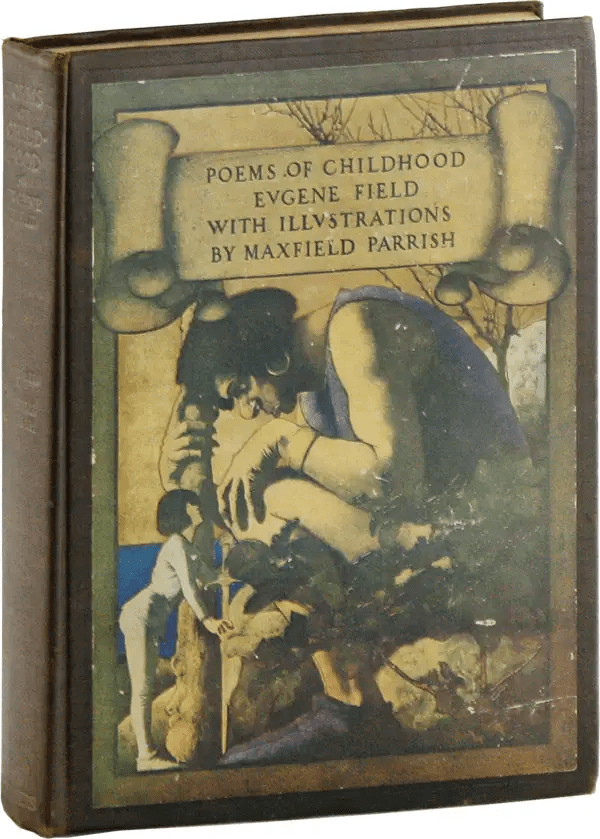

It was during the 1920s, however, that Parrish would enjoy a heightened level of notoriety and fame. By 1925 Parrish would shift away from illustrating for commission and focus more towards painting. By then he was wealthy in his own right, and I would say because of such success he felt liberated to paint more for personal enjoyment. Yet even at that, his later years of focusing more on painting not for commission still proved to be financially fruitful.
In 1922, Maxfield Parrish completed what he and many others consider his magnum opus, Daybreak.

An oil painting, Parrish used an assortment of techniques and adhered to several artistic principles (he was greatly influenced by the theory of dynamic symmetry) to create such an eye-catching and mesmerizing work. Parrish’s personal style and tastes are on full display; the dynamism of light, the blending and contrasting of warm and cool colors, the romanticist awe of the sublime combined with the neoclassical desire for order and balance all come together to show the best of what Parrish offers.
Well received then and now, Daybreak is still in print and has outsold other iconic prints such as Andy Warhol’s Campbell’s Soup Cans and Leonardo Da Vinci’s Last Supper.
Yet for some reason, unlike Warhol’s Campbell’s Soup Cans and Da Vinci’s Last Supper, Parrish’s Daybreak seems so much more forgotten and lost to history. It’s bizarre that young people today find Maxfield Parrish and his paintings so unfamiliar despite his major lifetime success and influence. In 1936, Time stated that “as far as the sale of expensive reproductions is concerned, the three most popular artists in the world are Vincent Van Gogh, Paul Cézanne and Maxfield Parrish.” How is it possible, then, that in the span of less than a century an artist as prolific as Parrish be left out of the conversation among laymen of art?
Admittedly, how I discovered Maxfield Parrish was by accident. I was at my grandparents’ house helping do some repairs and found myself in the basement. While down there, I was in my grandpa’s old workshop. I got curious of what was down there, and so I started rummaging around until I found a print of Parrish’s Daybreak leaning against the wall between a few other old paintings. As soon as I saw it, the work captivated. I pulled the print out between the other works of art and just took it all in. Despite its aged and dirtied state, the print still demanded my attention even after many years of collecting dust in my grandparents’ basement.
When I got home, I looked into the artist and what I found surprised me. His level of fame, notoriety, and success was not what I expected given that I had never heard of the name Maxfield Parrish until I found that old print. I’m glad I did, though, because I personally find his works enjoyable. Many of his works lie on the cusp of the dreamlike and the ethereal, yet at the same time they retain these grounded, heavy atmospheres. It is a delicate and iconic balance that I find makes his works worth remembering.
Parrish passed away on March 30, 1966 in Plainfield, New Hampshire. His influence in the world of art and beyond has been massive yet silent. In many ways, you have come into contact with his legacy without knowing it.
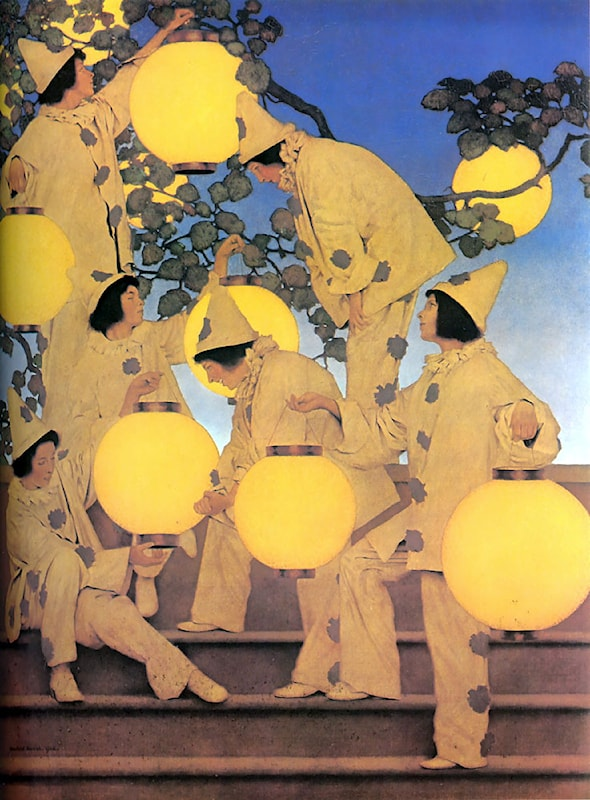
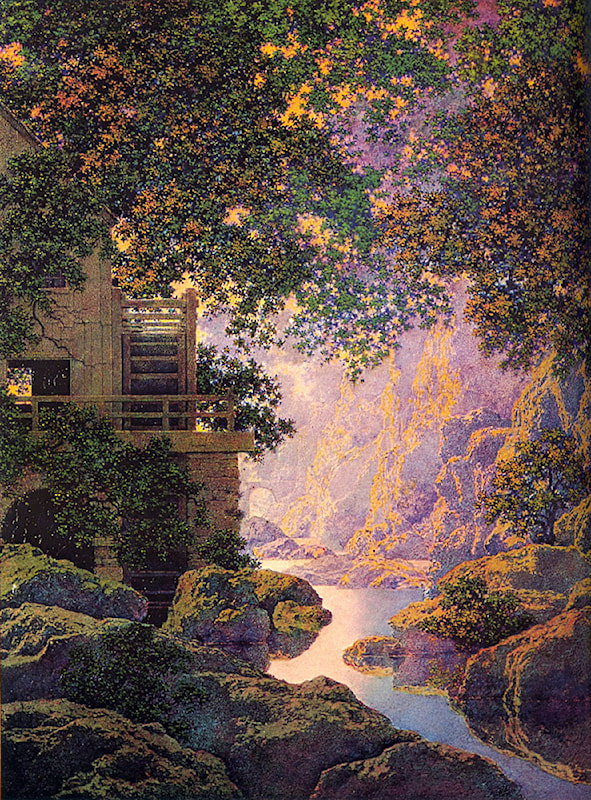
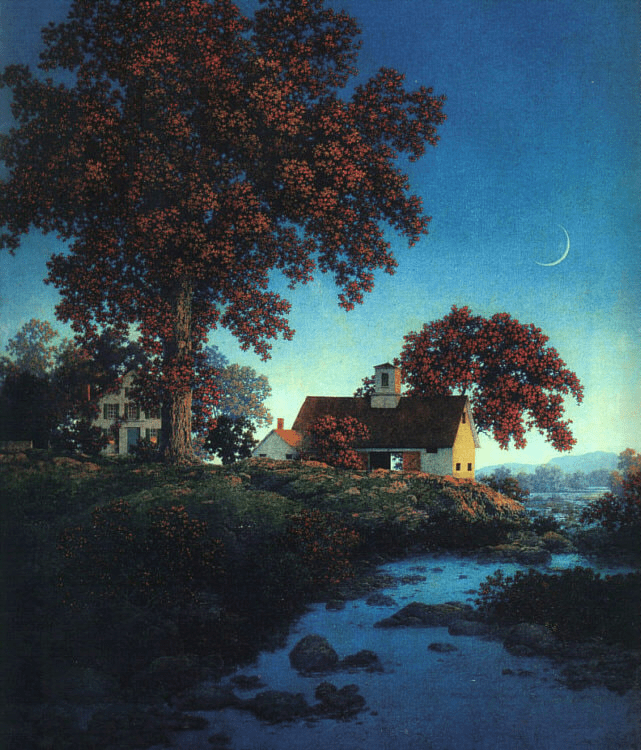
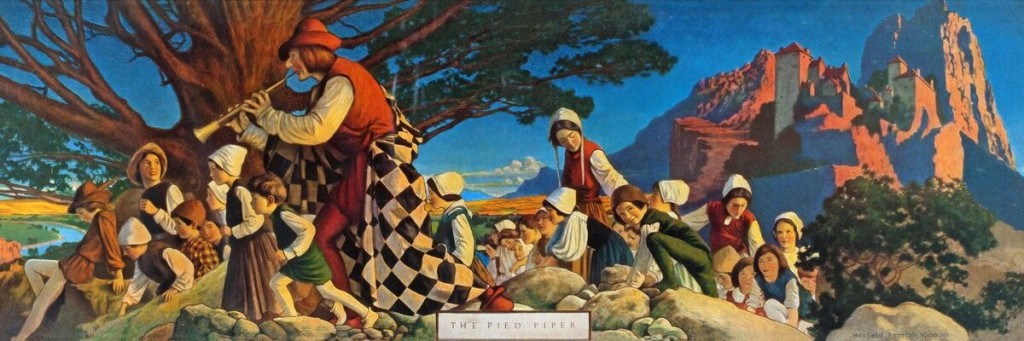
To get a better sense of Parrish’s oeuvre, I’ve included below a couple more of his works I find interesting.



Sources
Art Renewal Center, “Maxfield Parrish”
Lorne Bair Rare Books, “FIELD, Eugene; Maxfield Parrish (illus.)”
New England Historical Society, “Maxfield Parrish, A Mechanic Who Painted Fantastically”
Nocloo, “Maxfield Parrish – Illustrations for Arabian Nights 1909”
Pennsylvania Center for the Book, “Maxfield Parrish”
Traditional Fine Arts Organization, “Maxfield Parrish, 1870-1966“
Traditional Fine Arts Organization, “6. The Peak Years and the Magnum Opus: 1918-30”
 Neglected Canvases
Leave a comment